How Many Tyres Do You Need for a Collection? A Guide for Small and Large Businesses
For a business that replaces tyres regularly, the pile can grow surprisingly quickly. A small workshop might accumulate a few dozen used tyres over several weeks, while a fleet operator or tyre retailer can generate hundreds or even thousands. Naturally, one question comes up: what is the minimum tyres for collection, and when is it worth arranging a pickup?
The answer is not always a single number. Collection requirements can depend on the tyre recycler, your location, the type and size of tyres, transport arrangements, and how frequently you need pickups. Understanding these factors can help businesses plan collections more efficiently, avoid unnecessary storage, and arrange bulk tyre collection when the volume makes commercial sense.
For Australian businesses, there is also a compliance side to consider. Used tyres need to be managed responsibly, and requirements can differ between states. In NSW, for example, certain waste tyre loads must be tracked when they reach 20 tyres or 200 kg in a single load. So rather than simply waiting until the yard is full, businesses should consider volume, storage, collection frequency and regulatory requirements together.
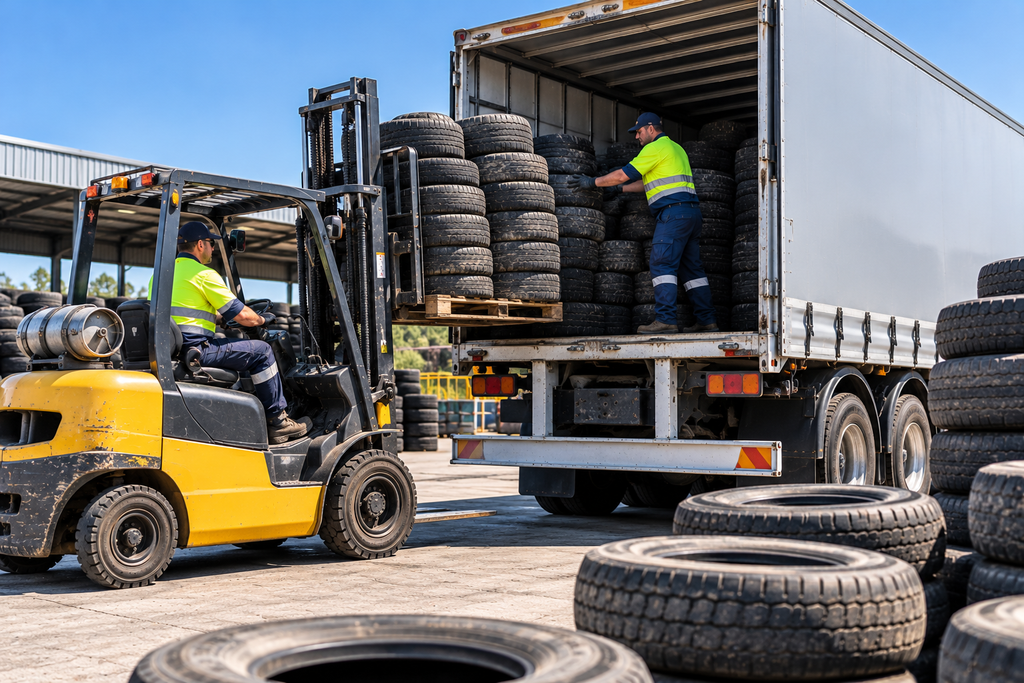
Is There a Minimum Number of Tyres for Collection?
There is no single Australia-wide minimum collection volume that applies to every commercial tyre pickup.
Instead, tyre recycling companies generally establish their own operational thresholds. These may be based on the cost of sending a vehicle to a site, the distance involved, available vehicle capacity, tyre sizes, loading requirements and the economics of transporting the material.
For example, a recycler may be able to collect a smaller number of tyres from a business located close to its regular service route, while a remote collection requiring significant travel may need a larger volume to make the trip practical.
This is why businesses searching for the minimum tyres for collection should avoid assuming that a number advertised by one provider automatically applies elsewhere.
It is better to ask:
- Is there a minimum number of tyres for my location?
- Does the minimum change for truck, OTR or agricultural tyres?
- Are pickup charges based on tyre quantity, weight, distance or a combination?
- Can smaller quantities be collected on a scheduled route?
- Is there a different threshold for regular versus one-off collections?
These questions can give you a much clearer picture of the actual collection requirements.
What Determines the Minimum Collection Volume?
Several practical factors influence whether a tyre recycler will collect a particular load.
1. The Number of Tyres
The obvious factor is volume. A collection vehicle needs to travel to your site, load the tyres and transport them to a processing or recovery facility. If only a handful of tyres are available, the transport cost can be difficult to justify commercially.
That does not necessarily mean small businesses cannot arrange collection.
A workshop generating 10 or 20 tyres this month might be better suited to a less frequent collection than trying to organise a pickup every week. Building the volume over several weeks can make each collection more efficient, provided the tyres can be stored safely and legally.
2. Tyre Size and Type
Ten passenger car tyres do not occupy the same amount of space as ten truck or earthmoving tyres.
Tyre size affects vehicle capacity, loading time and transport requirements. A collection involving passenger tyres may therefore have a very different practical capacity from one involving large commercial or off-the-road tyres.
This matters when planning tyre pickup volume requirements. Businesses should provide the recycler with an accurate description of the tyres rather than giving only a total count.
For example, a fleet manager should distinguish between passenger vehicle tyres, light truck tyres, heavy truck tyres and OTR tyres where applicable.
3. Your Location
Distance can have a major impact on collection economics.
A business located within a regular metropolitan collection route may have more flexible options than a site located hundreds of kilometres from a processing facility or established route.
For businesses in Melbourne and Victoria, for example, collection services can cover metropolitan and regional areas, but the practical requirements may differ depending on the location and volume. A provider’s local service page can give businesses a better idea of available arrangements, such as tyre recycling and collection services across Melbourne and Victoria.
The same principle applies across Sydney, Adelaide, Brisbane, Perth and regional areas: location should be discussed when requesting a collection rather than treated as a minor detail.
4. Collection Frequency
A business producing a steady stream of waste tyres has different needs from one clearing a one-off stockpile.
A tyre retailer might generate tyres every day and need scheduled pickups. A smaller mechanical workshop may only need collection once every few weeks or once a month.
Regular scheduling can make the process easier because the business knows roughly how much tyre waste it will have by the next pickup.
It also prevents the common problem of waiting until tyres have taken over valuable workshop or yard space.
How Small Businesses Can Manage Tyre Collection
Small workshops and independent tyre retailers often worry that their volumes are too low for commercial collection.
In reality, the better question is not simply “How many tyres do I have today?” but “How quickly do I generate tyres, and how often can I reasonably store them?”
Small Workshop Example
Imagine a workshop replacing approximately 15 to 25 tyres each week.
Arranging a collection every few days may not be necessary. Instead, the workshop could establish a collection schedule that allows tyres to accumulate to a practical volume before pickup.
This approach can reduce unnecessary collection frequency while keeping storage under control.
However, businesses should not allow tyres to accumulate indefinitely just to reach a preferred volume. Waste tyre storage brings its own safety, environmental and fire-risk considerations.
The EPA Victoria, for example, advises that waste tyres that cannot be reused need to be reprocessed at a suitable facility or appropriately prepared before landfill disposal, and large tyre pieces are restricted from landfill.
For small business tyre disposal, the goal should therefore be a balance between efficient collection and responsible storage.
How Large Businesses Should Plan Bulk Tyre Collection
Large tyre retailers, dealerships, fleet operators, logistics companies and councils usually have a different challenge: they need to manage volume consistently.
Instead of asking whether they have enough tyres for one collection, they should consider their expected monthly or quarterly tyre generation.
For example, a transport fleet could track:
- Number of vehicles serviced
- Average tyres replaced per month
- Different tyre sizes
- Seasonal changes in tyre replacement
- Number of operating locations
- Storage capacity at each site
- Preferred collection frequency
This information makes it much easier to establish an efficient bulk tyre collection schedule.
For multi-site businesses, centralising collections can also be useful where practical. However, transporting tyres internally between locations simply to reach a larger collection volume may not always make financial or operational sense.
A better approach is to compare the cost and logistics of individual site collections against a consolidated arrangement.
Why Tyre Storage Should Not Be an Afterthought
It can be tempting to keep accumulating tyres until a large collection becomes worthwhile.
But storage capacity is not unlimited, particularly for workshops operating in busy industrial or commercial premises.
A growing tyre pile can occupy valuable floor space, interfere with vehicle movements and create additional site-management concerns. Poorly managed tyre stockpiles can also create environmental and fire risks.
TSA highlights the importance of responsible management because tyres that are not recovered can end up in landfill, stockpiles or illegal dumping.
This is one reason collection planning matters. The cheapest-looking option is not always the most practical if it means holding waste tyres for an excessive period.
What About Australian EPA Requirements?
Waste tyre requirements vary between Australian states and territories, so businesses should check the rules that apply to their location.
NSW provides a useful example of why volume can matter beyond transport pricing. Under NSW requirements, waste tyres transported within the state must be tracked when a single load contains 20 or more tyres or 200 kg or more. Consignors, transporters and receivers have obligations under the state’s waste tracking system.
That threshold should not be interpreted as a universal “minimum collection” number. It is a regulatory tracking threshold for certain NSW waste tyre movements, not a national collection rule.
Victoria also has specific requirements around the management and disposal of waste tyres. EPA Victoria states that businesses should use an authorised facility or recycler where waste tyres cannot be reused, and it notes restrictions on whole or large tyre pieces going to landfill.
Before arranging a collection, businesses should therefore consider both the commercial requirements of their recycler and the environmental rules applying to their state.
Does TSA Accreditation Matter When Choosing a Recycler?
Tyre Stewardship Australia operates Australia’s national voluntary Tyre Product Stewardship Scheme and provides accreditation for businesses involved in the tyre supply chain, including collectors and recyclers.
TSA says its accreditation framework is intended to support responsible, transparent and environmentally sound tyre management. Accredited collectors and recyclers are also subject to compliance processes and reporting requirements under the scheme.
For a business arranging tyre disposal, this provides another useful consideration when comparing providers.
Instead of looking only at the number of tyres a company will collect, ask where the tyres are going, how they will be transported, what documentation is supplied and whether the provider can demonstrate responsible recycling practices.
When Should a Business Arrange a Collection?
There is no universal point at which every business should book a pickup.
A useful approach is to establish a collection trigger based on three things:
Your average tyre generation
Track how many tyres you produce over a normal week or month. After a few collection cycles, you should have a reliable estimate.
Your available storage space
Determine how many tyres you can safely hold without disrupting normal operations.
Your collection provider’s requirements
Ask about minimum quantities, vehicle capacity, geographic coverage, tyre types and scheduling options.
Together, these factors give you a practical collection threshold that is specific to your business.
What Information Should You Give a Tyre Recycler?
When requesting a collection, providing detailed information upfront can make the quoting process much smoother.
Include:
- Approximate number of tyres
- Tyre types and sizes
- Current storage location
- Business address
- Preferred collection frequency
- Whether tyres are loose, stacked or stored in another arrangement
- Any access restrictions
- Whether loading equipment is available
- Whether you require waste-tracking or compliance documentation
For large businesses, it can also help to provide historical collection volumes.
The more accurate the information, the easier it is for a recycler to determine the appropriate vehicle, collection schedule and processing requirements.
Practical Takeaways for Australian Businesses
If you are trying to determine the minimum tyres for collection, keep these points in mind:
- There is no single national minimum. Collection thresholds can vary between providers and locations.
- Tyre type matters. Large truck, agricultural and OTR tyres can require different transport and handling arrangements from passenger tyres.
- Location affects collection economics. Distance and route availability can influence whether a smaller pickup is practical.
- Small businesses can plan around regular accumulation. A scheduled collection may be more efficient than requesting frequent low-volume pickups.
- Large businesses should track generation rates. Monthly or quarterly data can help establish an efficient bulk collection schedule.
- Do not ignore storage requirements. Waiting for a larger volume should not create an unsafe or poorly managed stockpile.
- Check your state requirements. EPA rules differ across Australia, and some waste tyre movements have specific tracking obligations.
- Look beyond price. Responsible transport, recycling, documentation and compliance are important parts of commercial tyre disposal.
Frequently Asked Questions
What is the minimum tyres for collection in Australia?
There is no single minimum that applies across Australia. Collection requirements are generally determined by the recycler and can depend on tyre type, volume, location, transport distance and collection frequency.
Can a small workshop arrange tyre collection?
Yes. Small workshops can arrange commercial tyre collection, although the practical minimum may depend on the provider and location. Accumulating tyres over a reasonable period and arranging scheduled pickups can make collections more efficient.
Is 20 tyres the minimum for collection?
No. Twenty tyres is not a universal collection minimum. In NSW, however, 20 tyres or 200 kg in a single load is a threshold associated with waste tracking requirements.
How often should a business arrange tyre pickup?
It depends on how quickly the business generates tyres, available storage space and the collection provider’s requirements. High-volume businesses may benefit from regular scheduled collections, while smaller workshops may require less frequent pickups.
What should I do if I have a large quantity of waste tyres?
Contact a commercial tyre recycler with your approximate quantity, tyre types, location and preferred timeframe. This allows the provider to assess the collection requirements and determine the appropriate transport and recycling arrangement.
Conclusion
The right collection volume is not simply about reaching a particular number of tyres. For Australian businesses, it is about finding a practical balance between tyre generation, storage capacity, transport efficiency, collection frequency and environmental responsibilities.
Whether you operate a small workshop with a steady trickle of used tyres or manage a large fleet generating significant volumes every month, tracking your tyre output can help you plan collections more effectively. A qualified recycler can then assess your tyre pickup volume requirements and recommend an arrangement suited to your business.
If you are ready to discuss commercial tyre disposal, contact Dilway to discuss your tyre collection requirements and provide your approximate volume, tyre types and collection location.