What Is Tyre Stewardship Australia (TSA) and Why Does Accreditation Matter?
When a business replaces hundreds or thousands of tyres every year, the job does not end when the old tyres are loaded onto a truck. Where those tyres go, how they are processed and whether the process is properly documented can all matter to the business generating the waste.
This is where Tyre Stewardship Australia accreditation becomes relevant. TSA operates Australia’s voluntary Tyre Product Stewardship Scheme, bringing together tyre retailers, collectors, recyclers, fleet operators, councils and other participants with the goal of improving how end-of-life tyres are managed and recovered.
For Australian businesses, TSA accreditation can be a useful part of supplier due diligence. It does not replace state EPA requirements or make a business automatically compliant, but it can provide another indication that a tyre recycling provider has committed to recognised industry requirements, reporting and compliance processes.
What Is Tyre Stewardship Australia?
Tyre Stewardship Australia, commonly known as TSA, is the organisation responsible for managing Australia’s national and voluntary Tyre Product Stewardship Scheme.
The scheme was established to encourage better management of end-of-life tyres and increase the recovery and productive use of materials that would otherwise become waste.
TSA works across the tyre supply chain, including:
- Tyre retailers
- Tyre collectors
- Tyre recyclers and processors
- Fleet operators
- Local councils
- Tyre and vehicle manufacturers
- Organisations involved in tyre-derived materials
The idea behind tyre stewardship is relatively straightforward. Instead of treating a worn tyre as something that simply needs to be removed from a business premises, the industry looks at how the tyre can be collected, processed and converted into useful materials.
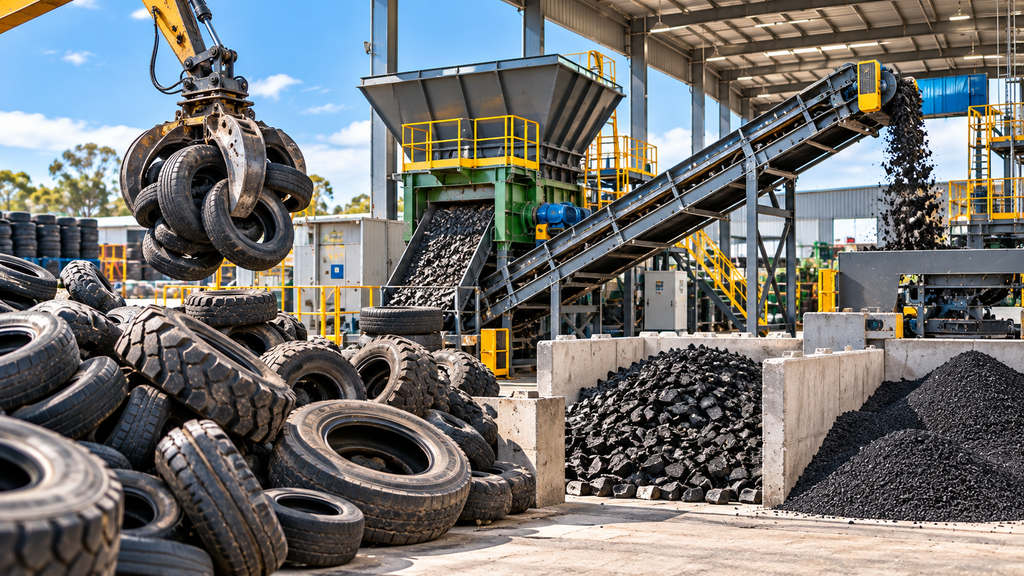
TSA explains that tyre recycling can produce materials such as rubber crumb, granule, shred, fibre and steel, which can then be used in new products and infrastructure.
For businesses interested in the end products created from recycled tyres, rubber crumb and granules are examples of materials that can be produced through tyre resource recovery.
What Is the Tyre Product Stewardship Scheme?
The tyre product stewardship scheme is a voluntary national initiative designed to improve outcomes for Australia’s end-of-life tyres.
Rather than focusing only on disposal, the scheme supports a broader approach involving responsible collection, recycling, resource recovery, market development and education.
Participation is open to different organisations across the tyre supply chain. That is important because tyre stewardship cannot be achieved by recyclers alone.
A tyre retailer influences what happens when a tyre is replaced. A fleet operator controls purchasing and disposal arrangements across potentially hundreds of vehicles. A collector controls how tyres are transported, while a recycler determines how much useful material can ultimately be recovered.
TSA’s role is to help create a network in which these different participants have clear responsibilities and incentives to manage tyres more responsibly.
What Does Tyre Stewardship Australia Accreditation Mean?
Tyre Stewardship Australia accreditation is formal recognition that a participating business has committed to the requirements of TSA’s scheme.
TSA states that accreditation is open to businesses and organisations involved in the tyre supply chain, including tyre retailers, collectors, recyclers, fleet operators and local councils.
For collectors and recyclers, accreditation is particularly relevant because these businesses sit directly within the end-of-life tyre management process.
An accredited participant is expected to meet relevant scheme commitments rather than simply displaying a TSA logo.
The accreditation process involves an application and review by TSA. Participants also have ongoing compliance and reporting obligations.
This makes accreditation different from a simple membership badge. It represents participation in a structured stewardship program.
What Does a TSA Accredited Recycler Have to Do?
A TSA accredited recycler has responsibilities that extend beyond physically receiving waste tyres.
While exact requirements depend on the participant category and activities involved, the accreditation framework includes several important elements.
Application and scheme commitments
Businesses applying for accreditation must provide information about their operations and demonstrate how they will meet the commitments relevant to their participant category.
For collectors and recyclers, this relates directly to the management of end-of-life tyres.
Compliance and audits
TSA has an audit and compliance program for accredited collectors and recyclers.
The TSA Collector and Recycler Audit Handbook sets out the processes used for annual compliance audits, accreditation assessment and dealing with non-compliance. This gives accredited participants a defined framework for maintaining their status.
Reporting
Accredited participants are also required to report relevant tyre-related activity.
For recyclers and collectors, reporting helps TSA build a clearer picture of how many end-of-life tyres are being collected and processed and how the Australian tyre recycling sector is performing.
Ongoing participation
Accreditation is not simply a one-time application.
Participants need to continue meeting their obligations, participate in relevant compliance processes and provide the required reporting.
For a business choosing a recycling provider, that ongoing structure is one reason accreditation can be useful during supplier evaluation.
Why Does TSA Accreditation Matter to Australian Businesses?
For a commercial tyre generator, the important question is not simply whether someone can take old tyres away.
The more useful question is:
Who is taking them, where are they going, and can the business demonstrate that the tyres were managed responsibly?
This distinction matters because waste tyre management is subject to environmental requirements at state and territory level.
For example, businesses in Victoria have specific duties around the transport, storage, use and disposal of waste tyres. NSW businesses can also have waste tracking requirements depending on the quantity and weight of the tyre load being transported.
TSA accreditation does not replace those requirements.
Instead, it gives a business another factor to consider when assessing a potential recycling partner.
A company choosing between several waste contractors can therefore look beyond price and collection frequency and ask whether the provider participates in an established industry stewardship framework.
TSA Accreditation Is Not the Same as EPA Compliance
This is one of the most important points for businesses to understand.
A recycler being TSA accredited does not mean every waste-management obligation has automatically been satisfied.
TSA accreditation and environmental regulation serve different purposes.
TSA operates the voluntary Tyre Product Stewardship Scheme and establishes accreditation and compliance requirements for participants.
State and territory environmental regulators, meanwhile, establish legal requirements concerning matters such as waste storage, transport, tracking, receiving facilities and disposal.
For example, businesses operating in Victoria should understand the current EPA Victoria waste tyre requirements, including requirements relating to transporting, storing and disposing of waste tyres.
This distinction is particularly important for commercial generators.
If a business simply checks for a TSA logo but never confirms whether the collection and receiving arrangements comply with applicable state requirements, it may overlook other responsibilities.
The better approach is to consider both.
How Can Accreditation Help Reduce Business Risk?
Commercial tyre disposal involves more than moving waste from one location to another.
A workshop, tyre retailer, fleet operator or council may need to demonstrate that its waste was transferred through an appropriate pathway.
This is where supplier due diligence becomes valuable.
Before engaging a recycler, businesses can ask:
- Is the business currently TSA accredited?
- What type of accreditation does it hold?
- Is the provider authorised to handle the relevant waste?
- Where will the tyres be taken?
- How are the tyres processed?
- What documentation is provided after collection?
- Is waste tracking required in the relevant state?
- Can the provider handle the business’s tyre types and volumes?
These questions do not guarantee compliance on their own, but they create a much stronger process for evaluating a waste contractor.
What Should Businesses Look for in a TSA Accredited Recycler?
Not every business generates the same type or quantity of tyres.
A small automotive workshop may have a steady stream of passenger tyres. A fleet operator may generate truck and commercial vehicle tyres. Construction, mining and agricultural operations can generate larger or specialist tyres that require different handling arrangements.
A suitable recycling partner should therefore be able to explain how its collection and processing system works.
Collection capability
The provider should be able to accommodate the volume and frequency your business requires.
Regular collections may be more appropriate for a high-volume tyre retailer, while smaller generators may need less frequent pickups.
Processing capability
Ask what happens after the tyres arrive at the recycling facility.
A responsible recycling process can involve sorting, size reduction, separation and recovery of materials such as rubber and steel.
Documentation
For commercial businesses, documentation is important.
Collection records, waste tracking information where applicable and other recycling or disposal records can help establish an audit trail.
Appropriate authorisations
TSA accreditation should be considered alongside any licences, registrations, permissions or other approvals required by the relevant environmental regulator.
This is particularly important when dealing with larger volumes or specialised tyre waste.
What Happens to Tyres After Collection?
One of the simplest ways to understand tyre stewardship is to look beyond the collection truck.
Once end-of-life tyres reach a recycling facility, they can go through several processing stages depending on the facility and intended end product.
Whole tyres may first be sorted before being mechanically processed into smaller pieces.
Further processing can separate rubber from steel and other components.
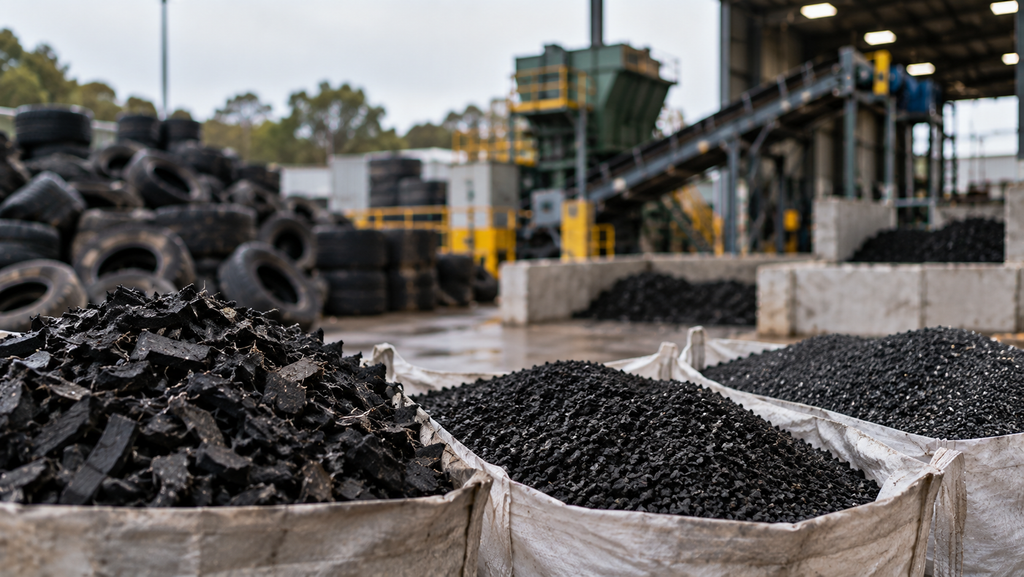
The rubber can then be processed into different particle sizes, including granules and crumb rubber. Other processing methods can produce tyre shred or other tyre-derived materials.
Steel recovered from tyres can also enter a separate recycling stream.
This is the practical side of responsible tyre recycling: the objective is not merely to remove tyres from a business site but to recover useful resources wherever appropriate.
Why Responsible Tyre Recycling Matters
Poorly managed tyres can create environmental and safety problems.
Large stockpiles can present fire risks, while illegal dumping can create long-term waste issues. Tyres can also occupy considerable space because they are bulky, durable and difficult to manage through conventional waste streams.
Responsible recycling provides an alternative by treating the tyre as a source of recoverable material.
Rubber from end-of-life tyres can be processed for use in applications such as sports surfaces, playgrounds, landscaping, construction products and other tyre-derived products, depending on its specification and intended use.
For businesses with sustainability or procurement objectives, this resource-recovery pathway can be more meaningful than simply measuring how quickly waste leaves the premises.
Does TSA Accreditation Help With Compliance?
It can support a business’s due-diligence process, but it should not be treated as a blanket compliance guarantee.
Think of TSA accreditation as one piece of the overall picture.
A business still needs to understand the environmental rules that apply to its own operations and location.
For example, if your business stores large quantities of tyres, storage requirements may apply before the tyres are ever collected.
If your business is transporting tyres, transport and waste-tracking requirements may apply depending on the jurisdiction and circumstances.
If your business is sending tyres to a recycler, it should also consider whether the receiving facility is authorised for the relevant activity.
The strongest approach is therefore:
TSA accreditation + appropriate regulatory compliance + proper documentation + a clear recycling pathway.
What Should Auto Workshops and Tyre Retailers Consider?
For workshops and tyre retailers, waste tyres can accumulate quickly.
A busy workshop may replace tyres every day, meaning the waste stream needs to be built into normal operations rather than handled only when storage space runs out.
Businesses should consider:
- How many tyres are generated each week or month
- Available on-site storage space
- Collection frequency
- Types of tyres generated
- Documentation requirements
- State-specific waste regulations
- Whether the recycler can accommodate changing volumes
Using professional tyre recycling and collection services can help businesses establish a more predictable process for collection and downstream recycling.
The same principle applies to fleet operators and councils, although their volumes and reporting requirements may be considerably larger.
Why Does This Matter for Fleet and Logistics Managers?
Fleet operations can generate substantial tyre volumes across multiple depots and locations.
That creates an additional challenge: consistency.
A fleet manager may need to ensure that different branches follow the same basic waste-management process, even when they operate in different states.
A documented recycling arrangement can make this easier.
Instead of individual sites choosing different disposal contractors, a business can establish clear supplier requirements covering accreditation, regulatory authorisations, collection documentation and recycling outcomes.
This can also make internal reporting easier when sustainability or environmental performance information is required.
What About Businesses Buying Recycled Rubber?
TSA accreditation is also relevant from the other side of the supply chain.
Businesses purchasing recycled tyre materials are not generating waste tyres themselves, but they are helping create demand for recovered materials.
This matters because recycling works best when there is a viable end market for the materials being recovered.
Rubber crumb and granules can be used across areas such as construction, landscaping, sports and recreation, depending on their specification.
Businesses sourcing these materials should consider particle size, consistency, application requirements and supply capability rather than treating all recycled rubber as the same product.
Creating demand for quality tyre-derived materials supports the broader resource-recovery cycle.
Three Practical Takeaways for Australian Businesses
1. Check the accreditation
If you are evaluating a tyre recycler, check whether it is currently TSA accredited and whether its participant category matches the services it provides.
2. Check the regulatory side
TSA accreditation does not replace state EPA requirements. Confirm that the provider has the appropriate permissions and arrangements for the waste it handles.
3. Keep a clear audit trail
Keep collection information, waste tracking records where required and relevant recycling documentation.
A clear paper trail can make it much easier to demonstrate how your business manages end-of-life tyres.
Frequently Asked Questions
What is Tyre Stewardship Australia accreditation?
Tyre Stewardship Australia accreditation is formal recognition for businesses participating in the voluntary Tyre Product Stewardship Scheme and committing to the requirements relevant to their participant category.
Is a TSA accredited recycler automatically EPA compliant?
No. TSA accreditation and state or territory environmental requirements are separate. Businesses should also check the recycler’s applicable licences, permissions and waste-management arrangements.
Why should a business choose a TSA accredited recycler?
Accreditation can provide an additional level of confidence that a recycler participates in an established stewardship framework with defined commitments, reporting and compliance processes.
What does responsible tyre recycling involve?
Responsible tyre recycling involves appropriate collection, transport, processing and recovery of end-of-life tyres, supported by suitable documentation and compliance with applicable environmental requirements.
What can recycled tyres become?
End-of-life tyres can be processed into materials such as rubber crumb, granules, shred and recovered steel, which can then be used in suitable downstream applications.
Conclusion
Tyre Stewardship Australia accreditation gives Australian businesses a practical way to identify tyre industry participants that have committed to the requirements of the national Tyre Product Stewardship Scheme.
For commercial tyre generators, however, accreditation should be considered as part of a broader due-diligence process. State EPA requirements, appropriate authorisations, waste tracking and reliable documentation still matter.
The practical goal is simple: know who is collecting your tyres, understand where they are going, know how they are being processed and keep evidence of the process.
For businesses looking to establish a more consistent approach to end-of-life tyres, Dilway provides collection, transport, recycling and compliance support for commercial tyre generators across Australia.